Sunday, 18 September 2022

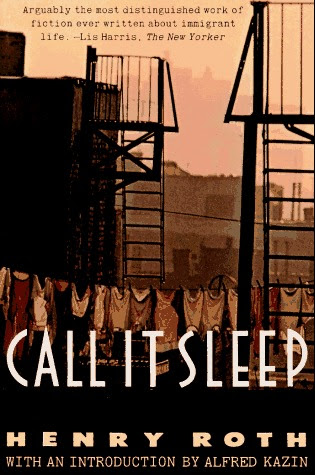
Call It Sleep, Henry Roth, 1934

Aristotle’s assertion that “poetic language must appear strange and wonderful” has been taken up and reworked time and again by theorists and writers as varied as the English Romantics and the Russian Formalists. Viktor Shklovsky, in “Art as Technique” writes, “the purpose of art is to impart the sensation of things as they are perceived and not as they are known. The technique of art is to make objects unfamiliar.”

Two things can be seen to follow from Shklovsky’s position: if perception is based on the interpretation of stimuli, physical and psychological, then any object, including the art object, can be rendered in completely unexpected ways. The onus is on the artist to juxtapose novel or conflicting ideas or images next to each other to create new ways of seeing something.

And the art object, product of a decontextualizing, defamiliarizing project, will elicit a multitude of responses, often initially of surprise or incomprehension. The audience expects to understand the art work but the comprehension is often momentarily — and deliberately — delayed.

Henry Roth’s dense, poetic first novel, “Call It Sleep”, published in 1934, makes ample but judicious use of techniques that bring about “defamiliarizing” sensations in the reader. 

The quote I have chosen to demonstrate my proposal comes from the prologue. And while this section is written by an omniscient, third person narrator and the remainder of the story is told through the eyes of the child/protagonist, David Schearl, startling or dramatic tropes used to describe the immigrant experience in New York city at the turn of the twentieth century are present throughout the text.

I have selected a short, four sentence description of the Statue of Liberty with which to show how Roth works language to create feelings that are unsettling.

“And before them, rising on her high pedestal from the scaling swarmy brilliance of sunlit water to the west, Liberty. The spinning disk of the late afternoon sun slanted behind her, and to those on board who gazed, her features were charred with shadow, her depths exhausted, her masses ironed to one single plane. Against the luminous sky the rays of her halo were spikes of darkness rowling the air; shadow flattened the torch she bore to a black cross against flawless light - the blackened hilt of a broken sword. Liberty. The child and mother stared again at the massive figure in wonder.”

To achieve defamiliarization Roth creates unusual, startling metaphors - the flame is a “black cross”, a “broken sword”; the rays of the statue’s halo are “spikes” that are “roweling the air”. 

He uses the language of violence to describe what he sees and perhaps what he feels about the statue - she is “charred”, “exhausted”, “ironed”, “flattened”. She is almost two-dimensional. The backdrop is also monochromatic: the sun has slanted behind Liberty  and the people on board the ship experience her as “shadowed”, “dark” and “blackened”.

A black cross has negative religious connotations. A broken sword signifies defeat. A rowel is sharp. These are unusual and unsettling initial images of the symbol that represents a land of opportunity, one that offers freedom. Feelings of menace and precarity are described in similar fashion throughout the book making it a truly dark novel.

“Call it Sleep” is also a marvel: it is the first novel of a young man who has written a Joycean-inspired story that has become a classic of American literature. 


Tuesday, 16 June 2020

Women in Love - D H Lawrence - 1920

While there is much to recommend the reading and re-reading of D H Lawrence’s Women in Love - from the precise and moving descriptions of the natural world and man-made environments to the psychological impulses that control the behaviour of people - the style and content of the novel elicits strong emotion, oftentimes positive but occasionally negative. On the one hand, readers love his descriptions of flowers and trees, the banks of a lake, the muddiness of a miner’s boots and the seductive way that he reports the colour and fit of a character’s clothes or the shape and feel of household objects. Many admirers applaud how strikingly well Lawrence is able to track the physiological and emotional modulations undergone by individuals as they contemplate sexual desire. Two days after Lawrence’s death in France, The Manchester Guardian published an obituary, laudatory in content and imitative of Lawrencian form which stated that his writing “made him a rebel against all accepted values of modern Western civilisation, one who challenged the disintegration not only of those who were actually caught in the blind mechanism of industry but of all who reflected a stultifying materialism either in a hard possessiveness, a soft emotionalism, or a sterile intellectualism.” The eulogy is all but explicitly referencing the main characters - Ursula, Gertrude, Rupert and Gerald.

On the other hand, many readers, some contemporaneous with Lawrence and others discovering his work in this new millenium have found aspects of his style and some of the underlying ideas that have shaped the content of the novel to be problematic and sometimes frustrating. T S Eliot writes that Lawrence is “the one contemporary figure about whom my mind will, I fear, always waver between dislike, exasperation, boredom and admiration.” A case can certainly be made for the notion that Lawrence’s content and style promote a kind of “bullying” or “declamatory didacticism”. Sometimes, he goes too far: when his style mimics what can be described as essentialist rhetoric (unmistakable in  “blood-knowledge”, “male vitality” and paradoxical couplings like “separateness in union”), readers are left wondering if, in his quest to create a new interpersonal paradigm and a new literature to express this new world, he doesn't begin to sound like a proto-fascist. 

It is true that D H Lawrence’s sexual politics are complex and not altogether palatable or justifiable, particularly to us, his modern readers, but it is also true that his prose is original, memorable and moving so perhaps the final word ought to go to him: 
Be still when you have nothing to say; when genuine passion moves you, say what you've got to say, and say it hot.


Thursday, 11 June 2020

Remembrance of Things Past - Marcel Proust - 1932 (English Edition)

Marcel Proust’s Remembrance of Things Past is a unique literary-philosophical text, exceeding the standards of the usual novel of both its time and ours in its breadth, depth and complexity. Committed students of these four thousand pages need to hold a multiplicity of elements in mind while reading the volumes. Some of the philosophical, psychological and literary ideas, as varied as Bergsonian reformulations of time and memory, the validation of the Freudian subconscious, and the use of stream of consciousness as a narrative strategy are all woven into the stories of several dozen eccentric characters. Modern readers are treated to long, unbroken reflections on the various categories of memory or aberrant love or the fanciful qualities of the imagination, for instance, all the while trying to follow plot lines and character development. If one adds the sometimes suffocating depth of detail presented by the narrators (sometimes omniscient, sometimes first person, sometimes he is a young man, sometimes old), the task of assimilating all that is written can appear impossible. 

But the effort expended yields considerable satisfaction if the reader persists to the last volume, Time Regained, where the novelistic responsibilities of the text are completed (the fate of all the characters is revealed, closure is established) and the philosophical underpinnings of the novel are distilled into a few pages of explanation. The narrator, after revisiting the the people and places that have shaped his life, after sharing with us some new secrets and introducing one or two new characters to the saga tells us of his epiphany:

Then a new light arose in me, less brilliant indeed than the one that had made me perceive that a work of art is the only means of regaining lost time. And I understood that all the material of a literary work was in my past life...stored up by me without my divining its destination or even its survival…

The message is hugely optimistic: the passage of time is not necessarily negative. In fact it can lead to a work of art: the narrator believes that if he can recall events, impressions and details of his life and then reshape them via his imagination, he will be able to transform a life lived and eventually finished, into a work of art that may resonate past his own death.

Monday, 11 May 2020

Waiting For Gertrude, Bill Richardson, 2001


Alice B Toklas is dead. Her bones are buried next to Gertrude Stein’s remains in the Pere Lachaise cemetery in Paris but Alice’s soul resides in the body of a feral cat. She is in exciting company as the souls of celebrities as famous and accomplished as Oscar Wilde, Jim Morrison, Maria Callas, Colette, Isadora Duncan, Heloise and Abelard, La Fontaine, Frederic Chopin, Sarah Bernhardt, Marcel Proust and a host of other cultural luminaries wander the cemetery, also in the bodies of cats. Each of these personages has changed only in form - their personalities are intact: they love and hate and lust after all that they did in their previous life. 
Poor Alice wants Gertrude but Gertrude’s soul has not yet found a feline host and the story begins to heat up when Alice sets a giant midnight orgy in motion, headed by the silent, slightly menacing but intoxicatingly sexy tomcat, Jim Morrison. Will the dozens of kittens born to the Pere Lachaise community two months hence yield up a new Gertrude? And who among the inhabitants is stealing body parts and trinkets? Who is opening letters and revealing secrets? 

 Waiting for Gertrude by Bill Richardson is a cleverly conceived, original and ultimately unclassifiable novel. If I were shelving this book in a library, I’d be spoiled for choice. It is part fable and Jean de La Fontaine, the original 17th century fabulist, himself a cat, chronicles, in mocking fashion, the goings-on in the community. It is part epistolary novel with letters flying from Oscar to Jim, Colette to her mother and also to Jim, Isadora to Modigliani. Waiting for Gertrude is part journal: many entries are penned by Alice who provides the reader with local colour and helps progress the plot. The book shares tropes with crime novels. It is certainly a romance where both consummated and unrequited love feature. It is a bedroom farce marked by mistaken identities and sexual innuendo, light pornography features as does the occasional slamming of doors and the “beating of hasty retreats” at just the right moment. But most of all, Waiting for Gertrude is a neo-gothic tale. It is subtitled a “graveyard gothic” and while it is comic and light of touch and not particularly scary, the usual elements that define a gothic novel are all there: omens and curses, the supernatural, nightmares, a mustachioed villain, a damsel (or two) in distress and a happy ending. If I were a librarian I would place Waiting for Gertrude on the “highly recommended” shelf with a tag that suggests it be read on a rainy Sunday afternoon.

Sunday, 22 March 2020

The Passions of the Mind: A Novel of Sigmund Freud by Irving Stone, 1971

This discussion of Irving Stone’s biographical novel, Passions of the Mind: A Novel of Sigmund Freud 1971, is my latest effort at amateur literary sleuthing. It has led me through essays on the changing definition of the biographical novel, the death of the liberal humanist subject, the rise and fall of the postmodernist subject and emerging 21st century movements like ecocriticism and Darwinian literary studies. 

Having finished the novel (a slow and thorough telling of a life, quite pleasant, if slightly formal in language) I next read an essay by the same author called The Biographical Novel, from 1957. It is a brilliant document, transparent in meaning and method, a work that captures the ideological presuppositions that have lain at the foundation of western ontological thought from Descartes onwards. His opening sentence captures the ideas and the mood, the self-assuredness and the belief in the existence of self-evident “truths” that informed the scholarship and zeitgeist of Stone’s era. 

Stone writes, “The biographical novel is a true and documented story of one human being’s journey across the face of the years, transmuted from the raw material of life into the delight and purity of an authentic art form.” If Stone’s definition is reliable and if he has followed the rules he has enumerated in his essay then “Passions of the Mind” ought to be considered a “true” and “documented” story of Sigmund Freud’s “journey”.1 And if the “raw material” is “transmuted” into an art form that is “authentic”, verifiable and if it is treated by expert hands, this biographical novel should be considered true. We can indeed know Freud: mid 20th century positivists like Stone tell us so and they teach us how to do it. 

Enter the postmodern biographer and reader and everything changes. Recent writers like Massih Zekavat2 investigate the history of the construction of identities and remind us of the paradigm shift that ushered in the postmodern moment. After 1970, thinking about identity and its representation moved laterally and the existence of the stable, unified subject disappeared. The quest for the “authentic” self became not only impossible but irrelevant.  The postmodern generation might expect a biographical novel based on the life of Freud to ask different questions, to be more speculative and to take more risks. To rewrite Stone’s definition, “the material selected from sources that are sometimes unusual or unauthorized or problematic will give up multiple meanings. The resultant ‘art form’ or text, while it will not produce something ‘pure’ or ‘authentic’, may nevertheless ‘delight’, particularly if it calls attention to its artifice.” Can we know Freud? Which Freud? Deleuze and Guattari’s Freud? Juliet Mitchell’s Freud? There are many to choose from.

Time passes. The postmodern subject grows old. The discursive language around issues grows strident. Contestatory positions appear and new appeals are being made to science to solve the problems brought on by the neglect of facts and figures. The individual is now reoccupying the agent position. Human nature is back and ecocriticism, Darwinian literary critics and other biology based movements applaud its return. 

What would Irving Stone make of these monumental shifts in the formulation of ideas about ourselves? Is it nature over nurture or vice versa? Are we whole or fragmented subjects? And who was Freud, in the end?

1Of the 837 pages that comprise the novel, 28 pages detail the scholarship involved in the researching of the book.
2Zekavat, Massih., Evolution of the ‘Subject’: Postmodern and Beyond., 2010

Wednesday, 1 January 2020

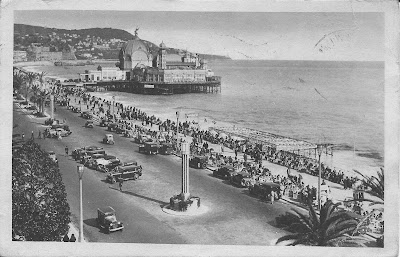
Un peu du passé - Marie Palumbo Argentieri - 2005

I love immigrant literature, particularly autobiographies, and especially those written by ordinary people who are able to distill experiences into a few, well chosen vignettes which quickly get at the heart of a life lived. Sometimes long, chronological, detail-laden books are undesired. Marie Palumbo Argentieri’s two slim volumes of reminiscences entitled “Un peu du passé” - “A Bit of the Past” are the perfect size for the reader wishing to spend an afternoon visiting the early days of an Italian family who emigrated to Nice, France in between the two world wars.


Argentieri, an amateur writer who has come late to writing, was born in Italy in 1924, emigrated to France while still an infant and published her work in 2005 at the age of 81. Her stories are written in simple, elegant French and they evoke feelings as varied as apprehension, pride, fear and contentment all the while avoiding sentimentality.

Argentieri describes certain small events that mark the family’s initiation into French society from their early encounters with authority (the police, the school teacher) and neighbours and co-workers (both French and Italian). These stories, however, are much more than gentle, episodic recollections of people’s struggles to assimilate into a foreign culture - they are also cleverly wrought little morality tales. The author’s narrative skills keep her audience curious about the outcome of the little adventures and indignities suffered by her family.

Argentieri manages the expectations of the reader, inserts details into the stories only when needed, and she uses dialogue to impart information that cannot be delivered any other way. Her style is economical and her narrative decisions are effective. The bicycle story exemplifies the author’s story telling skills. We travel with young Marie and her father to the commissariat's office to pay a fine they cannot easily afford, passing by the building’s facade upon which is sculpted an image of the scales of justice, “perfectly even”, according to Marie but which “sometimes tip in one direction” warns her father. Inside, we hear the father defending himself in broken French, sentences immediately followed by Marie’s clever translation of his words. She is politic and the fine is reduced. We all cheer - justice, dosed with humanity has  been served. The story of the crayons is equally lovely and well worth reading.

These stories have not yet been translated into English but the language is not difficult if readers have only secondary school French.

Saturday, 20 July 2019

Salvador Dali - Freud's Moses and Monotheism

Salvador Dali is a kind of magician whose sleight of hand is all his own: it takes the form of fanciful obfuscation, it plays with the audience’s expectations and confirms the long-held opinion that Dali’s art is ultimately more about Dali than the world it represents. Frequently, unashamedly and unselfconsciously, Dali will insert ideas and images derived from his early childhood experiences, or his dreams, or his self-professed obsessions into his artworks. Take his 1975 work entitled “Moses and Monotheism”, a set of ten lithographs which are based on his interpretation of Sigmund Freud's essay of the same title. Here, in each of the ten lithographs, two layers of material are superimposed onto the painted surfaces: the primary material, whose themes are suggested by the titles of the lithographs, and the secondary material, the intensely personal images, found again and again in Dali’s art but which bear no relationship to the primary work.

Ants, crutches, elephants with spindly legs and snails, four of his favourite recurring images, appear in the depictions of Moses and his travails. None appear in Freud’s text, none help to advance Freud’s radical proposals but a little bit of research into Dali’s meeting with Freud may explain at least one of the odder images. In “Moses Saved from the Waters”, Dali starts with the story of the three-month-old Moses, who in the Bible is placed by his mother and sister Miriam in a papyrus basket set afloat on the banks of the Nile. Dali paints water, sky and reeds in keeping with the traditional telling of events but substitutes a giant snail for the basket and adds crutches and bones to the scene. Moses is depicted as a baby with rays emanating from his head, one leg and arm are extended and he is lying in the opening of the giant snail which is being held up by bones. Crutches are holding the entire bizarre edifice above the water.

The snail does not, of course appear in the biblical telling of the Moses story, neither does it appear in Freud’s version of the story. It is wholly a Dali invention, borne, he tells us, of several moments where real-life snails produce epiphanies which involve Freud, at least tangentially.

One occurs on July 19th, 1938 during the much anticipated meeting between Dali and Freud. Dalí writes that he was captivated by the sight of a snail on a bicycle outside Freud's house and connected the snail with the image of Freud’s head.

Dali also writes that while eating snails in a restaurant in France he notices a photo of Freud in a newspaper. "I uttered a loud cry. I had just that instant discovered the morphological secret of Freud! Freud's cranium is a snail! His brain is on the form of a spiral - to be extracted with a needle!"

The question of why a snail houses a baby in its shell still remains unanswered, of course. All we know is that Freud’s cranium is a snail, snails transport angels, they save babies from drowning and in Dali’s world, anything goes.

Thursday, 7 March 2019

On Translating God's Name - David Goldstein - 1987


Imagine coming across an essay called On Translating God's Name. Could you ignore it and move on to something more conventional and less esoteric or would the subject matter intrigue you? If you’re seeking a challenge, pick up the article written by David Goldstein and be prepared to be perplexed and frustrated but certainly philosophically stretched. And entertained.

The article starts with a description of the etymology of the word 'cabal' giving both the negative and positive uses of the word and its derivatives. It then moves to other examples of short phrases, images and two-word oxymorons that have multiple or convoluted meanings and these explanations are book-ended by snippets of facts that give the reader hope that information about translating God's name is possible. Not so fast.

The article is made up of two layers of explication that cannot be decoupled and discussed separately because the subject matter is non-linear and highly poetic: first, the Zohar is a series of commentaries on the foundational texts of an ancient religion, the words of which are multi-definitional and so can be made to refer to numerous ideas or situations or moral positions. Second, the author is suggesting that the translation of the original text and the subsequent commentaries (commentaries on the commentaries are still being written and are therefore in need of translation too) is subject to the near-impossible task of finding English words equivalent to the ancient Semitic ones.

I am not without bible fire-power myself. Matthew tells us that John the Baptist announces that while he is baptising people with water, someone is coming who 'shall baptize you with the Holy Ghost and with fire'. That would be Jesus Christ. And the fire could also be a premonition of the fires that martyrs will be facing once the pagan backlash begins in late empire Rome. And today the phrase means jumping into a new situation unprepared. So, non-Biblical experts who enjoy reading about the construction of religious ideas and those who like complex wordplay take heed but tackle the text — the universe described is worth trying to unpack but it will most assuredly be a baptism by fire.

On Translating God's Name by David Goldstein appears in The Translator's Art, Essays in Honour of Betty Radice, edited by William Radice and Barbara Reynolds 

Wednesday, 5 December 2018

Les Hysteriques - Francis Berezne (2002-2008)

Painting One
The painting is predominantly black and white, impressionistic in style, the background is pitch black and the subject is a young woman, lying on a bed covered in white sheets. She is wearing a white night dress, her face is turned towards us, her eyes are wide open, eyeballs an unnatural white, this in contrast to her otherwise calm, serene demeanor.

Painting Two
The same figure is now sitting up on her bed, her head raised, looking at someone who is standing to her right. One arm is folded across her chest and the other is raised, bent, elbow held high, suggesting defiance. Perhaps she is resisting someone’s effort to restrain her. Her lips are downturned.

Painting Three
The background is again black, the figure is in her bed, lying down, her arms are crossed atop her chest, suggesting a supplicatory attitude.The young woman’s eyes are closed, she is smiling. Her bed frame is metal, the bars along the back and sides are vertical. It looks like a hospital bed.

Painting Six
Now, the figure is sitting up, her legs are crossed unevenly, one knee is higher than the other, her arms are lifted up high suggesting prayer, her eyes are raised, she is smiling, ecstatic, unnatural. This is the giveaway image for me — I now know what I am looking at: these are modern impressionistic paintings based on a series of photographs taken by hospital photographer Albert Londe in the neurology ward of the Salpetriere hospital in Paris in the latter half of the 19th century. The figure depicted in the original photos and immortalised in subsequent paintings, in reconstructions of hospital scenes in films and art galleries and in reproductions in science textbooks is Louise Augustine Glezies, a patient of Jean Martin Charcot, a doctor of neurology and exponent of hypnotism.

Painting Sixteen
Suspicions confirmed. And this painting is the biggest piece of the puzzle, one which unlocks the origin of these odd and unsettling paintings. A huge work, it isolates and enlarges a segment of a famous painting by Andre Brouillet (1887) which features Charcot, a group of colleagues and another favourite patient called Blanche Marie Wittman, a woman who was hypnotised at the weekly hospital meetings and made to enact, for the edification of the doctors and certain interested members of the public, the common pathologies associated with hysteria and epilepsy. In this painting, the patient is bent over backwards, supported by a doctor and two nurses while Charcot stands nearby and explains the drama to his audience. Coincidentally, Sigmund Freud, himself a student of Charcot, hung a copy of this painting in his consulting room in Vienna.

This collection of twenty four paintings is executed between 2002 and 2008 by French artist, author, teacher and mental health patient Francis Berezne. And despite the devastation brought on by mental illness (Berezne spends some twenty years intermittently in hospitals and eventually hangs himself at the age of 64), he produces some poetic writings and haunting paintings that portray beauty in impossibly troubling situations. Two years before his death he writes of this series of works,

It appears that those who look after these people want to classify them, their symptoms, their crises, as one classifies plants in a herbarium. The photographer is looking at them as a botanist discovering a specimen, or as an entomologist pinning a butterfly in a box. But the result is of great beauty, showing women extraordinarily alive, who suffer, who enjoy, who know limit states, who sometimes take pleasure in posing in front of the lens. I have chosen these photographs, brush in hand, for their undeniable beauty, because they speak of the human condition, the fate of women and madness in general.

This moving collection of paintings is called “Les Hysteriques” and occasionally travels to small art galleries.

Monday, 19 November 2018

The Ballad of the Sad Café, Carson McCullers, 1951

The Ballad of the Sad Café by Carson McCullers is a masterpiece of American Gothic writing. Published in 1951, the novella is set in a small town in the American south and populated by the bizarre, freaky, rural, ill-educated, violent and often lonely and bored characters that populate many of the novels and films that represent this tradition. In the case of Ballad, essentially a story of failed couplings, an impossible love triangle drives the action: Miss Amelia is the fierce, disagreeable giantess who is opaque of heart and in love with Cousin Lymon. Lymon Willis is a self-indulgent hunchback of indeterminate age, in possession of an inconstant heart and mad not for Amelia, but for Marvin Macy. Marvin is Miss Amelia’s spurned husband, “evil” by all accounts, and determined to take revenge on his wife for her rejection of his love. Love triangles are not uncommon in art, even when the characters are as unlikely as these three: a giantess, a hunchback, and a killer. But the nature of the love that each of these three offers and the reaction of the beloved to that love are quite unique and complex. In the case of Amelia, she marries reformed lothario and thug Marvin for reasons she doesn’t understand, and she resists his advances for ten nights, after which Marvin disappears only to return a decade later, a hardened criminal, bent on destroying Amelia. Amelia in time falls in love with Cousin Lymon, “spoils him to a point beyond reason”, ignores his “mischief making”, his rumour mongering, his masochistic attraction to Amelia’s enemy Marvin, and worst of all, his inconstant heart. Amelia is a woman troubadour, loving her beloved from afar, with a love that is chaste and turned on its head: her beloved is not good or fine or deserving of her care. What is the nature of this love? Cousin Lymon’s ears begin to twitch when he sets eyes on Marvin for the first time (Lymon is like a bat or a living gargoyle, ugly but attuned to his physical reaction to Marvin). He suffers abuse at Marvin's hands and foils Miss Amelia’s attempts to rid the town of Marvin's disruptive presence. Cousin Lymon’s love may well be homosexual, a latent sort, perhaps, chaste, and certainly unrequited but he is dogged in his pursuit of Marvin. Marvin Macey, the third factor in this bizarre sexual triangulation is cruel, abusive and feared by young girls in the community. His desire for the conspicuously hard and masculine Miss Amelia, his unexpected gift (he transfers his property to Miss Amelia, an act of selflessness, perhaps even a sign of self-emasculation), are all strange and inexplicable: he is a heterosexual man who loves a woman who is like a man who cannot consummate her marriage. Carson McCullers is the ideal person to write of the complexities of human sexualty, herself having had a fraught relationship with both men and women. The southern gothic atmosphere, the narrator, herself invested in the history of the town and the peculiar personalities that played out the life and death of the Sad Café has made for an unforgettable novella.


Saturday, 14 April 2018

Federico Garcia Lorca Little Viennese Waltz (Poet in New York 1929-1930)

The best a casual reader of surrealist-inspired poetry can do is enjoy the surprises and the non sequiturs that give form and substance to the art form. But  if one is even passingly familiar with the artist’s background, it can be helpful to call to mind details of that poet's life while reading the poetry. Federico Garcia Lorca's poem Pequeno Vals Vienes, translated as Little Viennese Waltz and Leonard Cohen’s Lorca-inspired song-poem Take this Waltz are lovely examples of the image-rich, emotive poetry that can result when a bizarre, haunting moment is captured by a talented artist.
Does Little Viennese Waltz have anything to do with Lorca’s depression and subsequent year-long pilgrimage to New york following a break-up with his lover, sculptor Emilio Aladren? When Lorca offers us “...this close-mouthed watz”, “this broken-waisted waltz”, “this waltz that dies in my arms”, “this ‘I will always love you’ waltz” and ends the poem with “my love, my love I will have to leave violin and grave, the waltzing ribbons”, is he bidding goodbye to the unfaithful Aladren? Who knows?
Perhaps Leonard Cohen knew. He named his daughter Lorca. He tells us that he discovered the poetry of Lorca at the age of 15 when, rummaging through a used bookstore in Montreal, he came upon a book of Lorca's poetry and experienced an epiphany which lead him to declare that he would become a poet in the style of Lorca.
But perhaps it’s not necessary to mine the lives of artists to discover the sources or the motivations that lead to their masterpieces. Perhaps it’s enough to be moved by the feelings aroused by beautiful art. Leonard Cohen’s Take this Waltz ends with this offering, “O my love, O my love, Take this waltz, take this waltz, it’s yours now. It’s all that there is.” Just a song, just a series of images, just a feeling. And perhaps that is good enough.

Thursday, 22 March 2018

George Nakashima (1905-1990)

A recent visit to a small cafe near the St. Lazare train station in Paris brought me to mind of the American Crafts movement and the woodwork of Japanese-American architect and furniture maker George Nakashima. The round wooden spindles hanging from a flat piece of wood, itself hanging from the ceiling, the large communal table made with two solid pieces of wood joined in the middle, and the wooden slats used to create ledges on which bags of coffee beans offered for sale are displayed all suggest a fusion of tradition and innovation, comfort and surprise.
I think the interior designers responsible for the look of Braun Notes may have had in mind the aesthetic that influenced late 19th century American architects and designers who sought simplicity and strength and insisted on the use of natural materials in their productions. And in design terms, the restroom might be the most interesting space at the cafe as the brass wash basin, the exposed copper pipe bringing water to a basic faucet and especially the long wooden counter running the length of the room, most bring to mind the Nakashima aesthetic. Braun Notes is, of course, a commercial enterprise built to sell a quick meal to a young, trendy clientele and not an art space (and as a restaurant it is not particularly comfortable or well-built), but its “look” certainly channels the philosophy that brought master designers and conservationists like George Nakashima to world attention. Nakashima was a forestry major who eventually received an MA in architecture. He travelled the world, studied traditional carpentry techniques in Japan, worked with Frank Lloyd Wright in India and mastered what he came to call the “free-edge” aesthetic and built “live-edge furniture”. His signature designs are his “conoid” chair and his tables made of slabs of wood with knots and burls, connected with wooden butterfly joints, smoothed out on top but left unfinished on the sides.
In his 1981 book, The Soul of a Tree, George Nakashima encapsulates his eco-art philosophy in these two sentences: “When trees mature, it is fair and moral that they are cut for man’s use, as they would soon decay and return to earth. Trees have a yearning to live again, perhaps to provide the beauty, strength and utility to serve man, even to become an object of great artistic worth.” Nakashima tables are glorious and Braun Notes makes a good espresso.

Sunday, 11 February 2018

Jean Luc Johannet’s Tower of Babel (1980s)


Carved on cliff faces in Lebanon at Wadi Brisa are two reliefs dating to about 500 BCE depicting the Tower of Babel. In late medieval Germany, Meister der Weltenchronik paints a charming little, five-storey tower standing beside a thatched workspace and half a dozen artisans busily constructing the modest tower. Two hundred years later, Dutch artist and map-maker Cornelius Anthonisz produces a dramatic etching of a colosseum-inspired building spiraling into the sky, the top smashed by a violent wind, chunks tumbling to the ground hitting people, and a small army of sword-wielding, trumpeting angels flying towards the catastrophe. In 2011, Iranian artist Goran Hassanpour assembles TV screens into a tee-pee shaped conical tower whose screens display different views of the same dramatic waterfall.

The story of the Tower of Babel has provided and continues to provide material upon which artists, historians, linguists, theologians and archaeologists build explanations for any number of positions and viewpoints.

Jean Luc Johannet’s Tower of Babel does not often travel as it’s fragile but currently it’s showing in Paris at the Halles St Pierre to the end of February 2018. It’s worth a look. It’s a gigantic pencil and china ink drawing made in the 1980s by a gifted polymath who is able to incorporate his training in architecture, sculpture, poetry and painting to produce a version of the Tower that is altogether unique. His work references the “naive art” movement exemplified by Ferdinand Cheval and the Catalan modernism of Antoni Gaudi. He also takes inspiration from Swiss set designer and sculptor H R Giger whose aesthetic sets the mood for the Alien films. Johannet’s Tower is a pyramidal structure built on a river, straining to reach a baroque sky and populated by mechanical birds, winged ships and shifting nightmarish flying creatures. The Tower itself looks alive, its projections resemble horned masks, giant cilia, rows of sardine-like statues and at least one monkey and snake embedded in other figures.

Johannet’s tower is the Lovecraft version of Dr Seuss’s Horton Hears a Who.

Wednesday, 24 January 2018

T.S. Eliot - Peter Ackroyd - 1984

Any student of modernism as expressed in world literature and especially in Anglo-American literature would nominate T.S. Eliot to the list of writers who wrote groundbreaking poetry, beginning with Prufrock in 1915, The Wasteland in 1922 and ending with Four Quartets in 1945. Peter Ackroyd’s 1984 biography of T.S. Elliot takes the reader on a well-observed, fair-minded journey through the life and career of a towering cultural figure whose public image was not altogether attractive. Eliot, we all know, was considered aloof, arrogant, self-absorbed, highly intelligent and highly sensitive. He held anti-semitic views and joined his friend and fellow poet Ezra Pound in espousing fascism. What we did not know, but may have guessed at, particularly after having read Old Possum’s Book of Practical Cats or watched the musical Cats was that T.S. Eliot had a sense of humour. Ackroyd reminds his readers that Eliot, while essentially a serious man — a product of his puritanical upbringing — nevertheless enjoyed light entertainment like detective fiction, music hall shows and American comic films (especially the work of the Marx Brothers). In his youth and throughout his life, Eliot read comic strips like the surrealistic, linguistically playful Krazy Kat and the classic, slapstick single strip Mutt and Jeff. At the offices of literary publishers Faber and Faber, where Eliot worked for some forty years, he liked to play practical jokes, including setting off firecrackers in the coal scuttle and a sending letter to the editor of the Times, proposing a "Society for the Preservation of Ancient Cheeses.” Ackroyd tells us that Eliot, a dedicated writer of letters, wrote to friends “rambling in a high spirited or nonsensical manner about nothing in particular”. Such humour even stretched to the envelopes, and those addressed to friends such as Clive Bell often had on them verse instructions to the postman. It is a pity that Ackroyd could not give us more examples of the lighter side of Eliot’s personality but a bit of light investigation has revealed that the Eliot estate refused Ackroyd permission to quote from the poet’s unpublished work or correspondences. However, the hefty, two-volumed “Letters of T.S. Eliot” were published years after Ackroyd’s biography and are available to all — enabling us to fill in the many details and also to look anew and with more intimate evidence at the life and times of the “Old Possum”.

Saturday, 4 March 2017

24 Hrs in Photos - Erik Kessels


Recently I became aware of a travelling exhibition whose subject matter, 21st century ”vernacular photography” intrigued me: Erik Kessels is a Dutch “vernacular photography” collector, curator and photography magazine editor who has been watching photographic trends with some trepidation so, in 2010, he decided to curate an unusual show which would invite the general public and cultural critics to think about emerging trends in electronic art practices.
Kessels printed close to one million random photos, all of which were published in one 24 hour period on Flickr. He then dumped those photos, weighing about two metric tonnes, into venues as varied as art galleries and churches, from the Netherlands to North America between 2011 and 2015. Inviting the public to walk on them, lie on them, pick them up and look at them, he asked people to essentially confront and make sense of the explosion of amateur photography that has resulted from the availability of good, cheap digital cameras and the concomitant unlimited number of photos that are now taken and shared electronically, daily, around the world.
Kessels’ installations, while dramatic, are hardly a celebration of the easy taking and casual sharing of photos on social media networks. In fact, he explains that this installation was meant to “present (the photos) as a sea of images that you can drown in”. He’s reminding us of “how public your private photos have become” and he says he wants to leave visitors feeling unsettled as we’re “walking over personal memories”. Kessels’ installations and various comments seem to be suggesting that contemporary vernacular photography, by its dubious quality and sheer quantity, trivializes experience. Too many photos are taken; they are not curated, organized, made into manageable, related tranches (he himself is a collector of family photo albums purchased from flea markets and displayed lovingly in art galleries), and they are released without context into the ether, their anonymity ultimately depriving them of meaning. The venues into which he dumps the photos also make statements. When the hills of photos cover museum floors, he asks us to decide if these giant mounds are works of art or installation art. Are they anti-art, post-art statements? What are we to make of photos he shoots of a priest standing on the museum floor reading a bible, or two monks standing against a wall facing the camera? He dumps two tonnes of photos in a church in France, covering the pews and he photographs a family sitting looking at the hills of photos. Is Kessels suggesting that the spiritual is being co-opted by the material?
I understand the impulse that compelled Kessels to execute this exhibition: he is concerned about quality of representation and communication being overtaken by sheer quantity of visual material available but his vision is only one side of a complex and not altogether negative trend.

Saturday, 11 February 2017

Chronicle of a Death Foretold by Gabriel Garcia Marquez, 1984

It is bold to assert that the central theme of any novel is merely “silence, no change”*, but Gabriel Garcia Marquez’ tragicomic novel “Chronicle of a Death Foretold” may be just  such a work.
The novel begins “On the day that they were going to kill him, Santiago Nasar got up at five-thirty in the morning to wait for the boat the bishop was coming on.” and it ends early the next morning with “They’ve killed me…”. In the last seconds of his life he even took care to brush off the dirt that was stuck to his guts... went into his house...and fell on his face in the kitchen.”
Little is recounted of the events  between these two statements that doesn’t have a direct bearing on an incident that so overwhelms a town and yet changes nothing of its mindset.
The death of Santiago is the main event; it is inevitable; it is predictable, and while the circumstances and the blame remain contested, the townspeople remain in perpetual limbo. The reader is left wondering how such an extraordinary series of circumstances fails to change the thinking of the community or cause it to reassess the disproportionately violent response to what many might consider just a social infraction.
We are told time and again that Santiago Nasar is “fated” to die at the hands of twin brothers Pablo and Pedro, who are compelled by the dictates of tradition to restore the lost honour of their sister, without recourse to the law (which is an ancillary force to be dealt with after the fact) or even to honest inquires made before serious action is taken..
Did Santiago actually take Angela’s virginity? All evidence points to his innocence. Angela’s brothers seek no verification, they merely react to the ancient command to save face, to restore the family reputation with obligatory brute force.
Does the town ever own up to its responsibility? Everyone is sorry it happened, but it was “fated” to happen and it may well happen again: consensus is universal, hence the conclusion, ”silence, no change”.
The narrator presents testimonies (fresh from the moment and from 27 years later, when he revisits the town) and legal documents (compromised and fragmentary, many lost in the flooding of the courthouse) depicting characters who choose to remain blind to their collective guilt and, hence, unwilling to change. In “Chronicle of a Death Foretold”, Garcia Marquez is asking the reader to recognise the consequences of a culture locked in an antiquated and dangerous worldview.


* L.A. Times review, 1984

Sunday, 27 November 2016

A Brief History of the Great Books Idea by Tim Lacy 2005

North American culture has embraced, rejected and, in recent times, re-embraced the idea of reading the “great books”. Allan Bloom’s “first volley in the culture wars” with the now infamous “Closing of the American Mind” published in 1987 was far from the beginning of the debate.
We can thank English Victorian poet and culture critic Matthew Arnold (1822-1888) for laying down the notions that eventually lead to the establishment of  liberal arts colleges and reading groups that read “canonical” texts that disseminate “universal principles” to the “common reader” in order to promote the “common good”. If this language sounds familiar and if a little background to the debates is welcome, then I recommend a thoughtful little essay by Tim Lacy called “A Brief History of the Great Books Idea”.
Lacy’s essay takes us on a chronological journey starting with the England of Matthew Arnold and ending with the New York educator and social critic Earl Shorris (1936-2012) and his ongoing Clemente Course which has national (and now international) chapters that brings great books to the disadvantaged, exposing them to the edifying impulses “inherent” in great poetry, logic, history and moral philosophy.
As part of his overview, Lacy quickly and efficiently lays out the academic hesitations and shifts in public opinion that have led to serious but sometimes absurd and naive debates over appropriate content. Unsurprisingly, ideas of political economy authored by Karl Marx and Friedrich Engels are mentioned more than once: Lacy tells us that in the early 1930s, Charles Walgreen, founder of the drugstore chain threatened the University of Chicago with funding cuts if “subversive works”, which were “forced” on his niece were not removed from the curriculum. Walgreen lost out to the idea of open inquiry and Das Kapital is still taught at the university today.
Also on the lighter side is Lacy’s description of Dr Charles Eliot’s colourful career. He tells us, for instance, that Eliot (1868-1909), president of Harvard and editor of a “five-foot shelf of books” which contains the classics of Western thought,  believed that the set could offer a full liberal arts education to any adult willing to read from them for ten minutes a day. 350,000 sets were sold to households from 1909, when they were first issued, to 1930. Today, the set is available to download for free.
Finally, and on a more serious note, Lacy describes how the term “plurality of excellences” has in recent times, been substituted for the older idea of “excellence”, a shift that has necessitated a reassessment of “greatness”. Where “excellence” used to be found in largely Western, European and Victorian thought, the category has in the past 30 or 40 years expanded to include Eastern and contemporary texts. But what happens, Lacy asks, if “no central standard of excellence is imposed to construct the list (of necessary reading)”?
The debate over the very existence of “permanent, universal values and the persistence of the dream of a common culture” is of course ongoing and deep, and while Lacy’s essay only hints at the fractious nature of the dialogue, it is up to the interested reader and both friends and foe of Allan Bloom to thrash it out.


Tuesday, 1 November 2016

Strangers from Abroad by Daniel Maier-Katkin 2010

It is generally acknowledged that philosopher Martin Heidegger effected a kind of paradigm shift in thinking about the world and about thought itself when he asked us to put aside western philosophy’s foundational binaries idea/object or mind/matter and formulated anew, the meaning of being and thinking, this time viewing all that exists through the specificities of time and history. His work led to philosophical movements as varied as phenomenology, hermeneutics, existentialism and post-structuralism, and yet since 1940 and rather frequently in recent times, his work has made news not only in academic circles where one would expect his ideas to be critiqued but in the popular press because new evidence regularly surfaces tying him more and more firmly to his pro-Nazi past. The fact that he was, for a brief period, a Nazi party member, wrote about the menace he perceived inherent in Jewish rootlessness and cosmopolitanism, and still had an intense love affair with his star Jewish student, Hannah Arendt, continuing to see her until her death, multiplies the dimensions of the story considerably. Add the fact that Arendt, herself the object of public scorn, forgave him for his refusal to recant his anti-semitism adds yet another extraordinary and certainly perplexing element to the history of this relationship. Understandably, much has been written about these two international figures, including a book by Daniel Maier-Katkin called Stranger from Abroad: Hannah Arendt, Martin Heidegger, Friendship and Forgiveness, published in 2010. I recommend this book, particularly to those who enjoy psychological puzzles. And it can probably be agreed that the Arendt/Heidegger puzzle is amongst the more unusual of the recent past.
Stranger from Abroad lays out the controversies, introduces major and minor actors, theories, and provides quotes from many sources, including letters from the two protagonists but in the end it cannot resolve the Arendt/Heidegger enigma.
How deep was Heidegger’s anti-semitism? Did it go beyond personal opinion? Did it have philosophical ramifications? If the latter is the case (debates are ongoing), then what is one to do? Discard “Being and Time” and all those ideas that have been built upon Heidegger’s work?  And what of Arendt’s forgiveness of Heidegger? Was it willful blindness, naive adoration of a love object, or considered, rational thinking that kept her at Heidegger’s side?
Neither Maier-Katkin nor any other writer of recent times has been able to tell us.


Sunday, 4 September 2016

Raphaël et la Fornarina XI, from La Série 347 by Pablo Picasso (1968)

In the span of 12 days in 1968, when he was 87 years old, Pablo Picasso made a series of 25 etchings that depict erotic episodes involving Raphael and his mistress Margherita Loti, known as La Fornarina (The Baker’s Daughter). Because it is Picasso and Picasso was a committed, promiscuous and successful borrower of style and subject matter originating from multiple places and historical moments, a small investigation, even a cursory one of these two dozen etchings yields names and references as varied as Michelangelo, the Vatican, Jean Auguste Ingres and psychoanalysis.
This little study is built upon the story of Raphael and his appetites, which is entertaining in and of itself but the story also offers a convenient way to mention some of the foundational ideas about sex, art, and inspiration held by Picasso.

First, we can say that Picasso’s statement “sex and art are the same thing” suggests ideas of sexual energy, sublimation, creativity, paraphilia, all terms familiar to us as post-Freudian subjects. In fact, it can be argued that when Picasso draws Raphael painting a portrait of his mistress while simultaneously making love to her (Raphael has paintbrush and easel in hand while he penetrates Margherita), Picasso is making art in order to sublimate sexual energy. In short, the artist, the exceptional man, can have it both ways: the paintbrush and the phallus can both satisfy and be satisfied.
And what of sex as compulsion? In several of the etchings we see Pope Julius II, sometimes sitting on a throne, sometimes on a chamber pot (his behind in full view), sometimes hiding behind a curtain, watching, and sometimes in full view of the lovers in action. Picasso’s message is clear: while the office of the Pope is meant to confer respect to the man who represents divine power on earth, this pope is a voyeur who permits the forbidden (sexual gratification — his and his employee Raphael’s — against the codes of Catholic orthodoxy), making him and his office mere objects of fun.
The other figure that lurks in these sketches, often hiding underneath the bed, is Michelangelo. The story (from Giorgio Vasari) goes that Raphael, curious, needing inspiration, viewed the work in progress in the Sistine Chapel without permission and proceeded to copy the style. Michelangelo never forgave him for stealing, uttering “Everything he knew he learned from me.”. Three hundred years later, Jean Auguste Ingres borrows from Raphael, painting “Raphael and The Fornarina”, using his own mistress Madeleine Capelle and justifying his borrowing by asking, “Is there anyone among the great ones who has not imitated? Nothing is made with nothing.”. A century and a half later, the Ingres painting provides Picasso inspiration: he too, sketches the lovers, claiming “good artists copy, great artists steal”. Perhaps Picasso is saying that a good artist merely transports theme and image from one canvas to another, one age to another, but a great artist transforms previous art so that it suggests a new and different understanding of life.
In these 25 sketches Picasso plays with ideas of patrimony, ego and method and besides challenging us, he makes us laugh a little.


Thursday, 21 April 2016

The Mandarins by Simone de Beauvoir (1954)


Despite the overwhelming consensus amongst its readers (from its initial publication in 1954 to present times) that “The Mandarins” by Simone de Beauvoir is a “classic” novel, mixed assessments of its literary value persist. Divergent views are inevitable, in part, because “The Mandarins” overlays political opinion, historical detail and philosophical debate on to the fictional form. For many readers, including myself, too much is being asked of the novel: the large political and sociological problematics that occupy so much of this book undermine the storyline and the psychological rendering of character, making the novel, at times, tedious. Some reviewers find “The Mandarins” to be a soapbox for political ideas or an apologetic for Stalinism and not at all a genuine work of fiction that seeks to understand how people experience a complex world. Critic Norman Podhoretz writes in 1956 that the novel is essentially just a critique of American capitalism. Unfair! The book is more nuanced than that: many of the characters in the novel struggle with the problem of divided loyalties. They ask if one can maintain one’s allegiance to an ideology that has been thoroughly compromised, and at what cost. I prefer critic Anna Banti’s contention that “The Mandarins” is really “an essay that is novelized”, where characters struggle with complex issues.

As simply a novel, a work of the imagination, free of polemical intent, some readers still find it wanting.  On Good Reads, I read comments like, “It is a big, baggy thing in need of an editor and a plot arc” and “the novel is full of flat characters whose voices are scarcely distinguishable, awkward dialogue and insipidly clunky internal monologue”. I, too, admit to finding the characterization sometimes tedious: too much time is spent watching Paula lose herself to mental illness, Nadine to adolescent angst, and Anne to self-doubt. However, the novel offers us a chance to see how people in post-war France and to some extent America (Anne spends time with her American lover Lewis in the United States) were beginning to react to changing social and sexual mores.
I would suggest that while “The Mandarins” is too long (700 pages) and repetitive, lacks a plotline and is short of suspense (although a murder takes place in the penultimate chapter but is oddly immediately forgotten), the work remains important. German reviewer Francois Bondy speaks for many of us when he writes that this book is really a “roman a clef” and should be read as a complement to de Beauvoir’s memoirs, a record of an important cultural movement rather than purely as a work of fiction.